Introduction
The Holy Supper [Svjatyj Vecer'] on Christmas Eve occurs among the people of Central Europe as the immediate preparation to welcome the birth of the Lord Jesus Christ. While it varies in details from one group to another and, in fact, within groups and nations from one town and village to the next, there are certain common features. This booklet is an outline to help you arrange your Holy Supper. As people have done for centuries, you must develop your own family traditions within the general parameters of the outlines given. This booklet can serve as a guide.
The origins of the Holy Supper predate the arrival of Christianity in Central Europe. Like many Christmas customs, it began as a pagan rite, in this case, called Korochun - the greeting of the Sun - as the days grow longer after the Winter Solstice. Certain elements, like the twelve courses to be served reflect the twelve months of the year and, expressing hope for a bountiful harvest of food for the whole year, hearken to its origins as an agricultural ritual feast for blessings in the year to come. When Christianized, the twelve courses were seen to represent the Twelve Apostles. Likewise, the Paska-like bread in the center of the table called the Korochun, comes to be understood as the sign of Christ, the Bread of Life. This foundation of the meal as a pre-Christian agricultural ritual meal explains the presence of the many "good luck" practices associated with the meal. In this rendition, these have been generally omitted.
Preparation
December 24 was observed as a day of strict fast, that is, no meat or dairy products were consumed. Some observed the strict fast until the sighting of the first star. Then, the fast was simple abstinence from meat. Others kept the strict fast until midnight. This accounts for the varying recipes, some without dairy products, some with, but all meatless. Today, it is suggested that we observe abstinence on Christmas Eve, that is, no meat products, but not restricting the use of dairy products. The meatless meal should be one of great abundance: meatless, to symbolize the humility and poverty in which Christ was born; the variety and abundance of food to remind us of God's blessings and grace.
The house is cleaned for the coming of the Messiah, and the dining room is specially prepared. The husband is to feed all the animals, whether the household pets or, if one lives on a farm, the farm animals, with great abundance. Likewise, after the wife sprinkles the family with holy water during the Holy Supper to purify their minds that they be open to accept the mystery of the divine birth, the husband is to bless the animals with the holy water. All this is done as a sign that the animals of the stable were the witnesses of the mystery of the birth of God in the flesh.
A candle is placed in the window, a sign of welcome for the holy family and, indeed, for family, friends, and the poor or strangers who have nowhere to spend the night like the holy family had no place to stay at the inn at Bethlehem.
The dining room table is set with a white table cloth, a symbol of purity of the Virgin birth and the white swaddling cloths. The husband will scatter straw over or under the tablecloth, to symbolize the manger, and place hay under the table, to transform the dining room into the stable. The Nativity Bread (sometimes called the Korochun), a round bread like the Paska, representing Christ, with a candle in the middle representing both the star and Christ who is the Light of the World, is placed in the center of the table. An extra full place setting, to remind one of the faithful departed of the family, and, at the same time, to serve as a prepared place for any who come in search of a meal, is set.
Wine glasses for the toast are set, and two small bowls of honey, one for the anointing and one for dipping the garlic, are set. The holy water the family had reserved from the previous Theophany - January 6 - is placed on the table. The husband hides the small presents and candies throughout the rooms.
The Foods
The Holy Supper is served with twelve courses. These varied from town to town and from one family to another. Traditionally, these consisted of:
Appetizers: pickles, herring, pickled mushrooms;
A Soup: sauerkraut and bean, mushroom, caraway, split pea, beet;
Bolbalky: small, bite-sized bread served with poppyseed, sweet cabbage, or sauerkraut;
Fish: an entre of fish, either baked or broiled, is served with: meatless stuffed cabbage (mushrooms and rice), pirohi, pagach or lokša (breads with cabbage or potato) beets, sauerkraut;
Dessert: stewed prunes, kolachi (nut, poppy seed, prune, or apricot cake roll), medovniki (honey cookies), kruschiki or cheregi (a fried, crispy pastry).
These are some of the traditional fare of Central European peoples. If you trace your lineage to other ethnic and national groups, you should form your holy supper with the foods of your tradition.
The Holy Supper
Appearance of the First Star
When the children of the household see the first star appear in the night sky on Christmas Eve, the Holy Supper begins.
The Announcement
The husband enters the dining room with hay and straw, saying:
We wish happiness, fortune, and health with the approaching Feast Day of the Nativity of our Lord, and we hope all of us may live to another Christmas, live in peace and happiness, and we ask God's blessing upon all of us.
He then spreads hay on the floor, and straw on the table, either under the table cloth or upon it. The Nativity Bread with the candle in the center is placed on the table, the Nativity icon or the creche is placed in the room which has now become the stable in Bethlehem; the table, the manger; the Nativity Bread, the symbol of the Infant Jesus.
The Washing
All present wash their hands. Sometimes a pitcher and a bowl with coins in it are used.
Prayer
The family begins the Holy Supper with a prayer. In some traditions, the Holy Bible is read. In most traditions, the Lord's Prayer is prayed.
Family: In the name of the Father, and of the Son, and of the Holy Spirit. Amen. Our Father, who art in heaven, hallowed be Thy Name. Thy kingdom come, Thy will be done on earth as it is in heaven. Give us this day our daily bread, and forgive us our trespasses as we forgive those who trespass against us. And lead us not into temptation, but deliver us from evil. For Thine is the kingdom, and the power, and the glory, Father, Son, and Holy Spirit, now and ever, and forever. Amen.
The Lighting of the Candles
The candle in the Nativity Bread, those on the table and the one in the window are lit.
There was a time when you were in darkness, but now you are light in the Lord. Well, then, live as children of light. (Epistle of Saint Paul to the Ephesians 5:8)
He rescued us from the power of darkness and brought us into the kingdom of his beloved Son. Through him we have redemption, the forgiveness of sins. (Epistle of Saint Paul to the Colossians 1:13-14)
All bow their heads and pray the following:
O heavenly Father, be pleased to accept this action of ours, as we commemorate the birth of your Son, the Light of the world. May these lights of ours help diminish the darkness of night, give witness of our faith in You, and serve as a beacon of welcome to You and to all who come in your name. O Savior of the world, be pleased to dwell with us, both in heart and home. Amen.
Blessing With Holy Water
The wife sprinkles everyone present with holy water.
The Toast
The husband offers the toast:
I greet you with the feast of Christ's Nativity and wish that the Infant Jesus shower upon all of you his choicest blessings. May God grant eternal memory and heaven to the departed. May we all live in health, peace, and happiness, and may we all celebrate another Christmas together.
The wife answers: May God grant it! (Daj Bože). She then expresses a similar toast, to which all answer:
May God grant it! (Daj Bože).
The husband continues:
A Merry and Blessed Christmas! Christ is born! (Christos razdajetsjâ!).
All answer:
Glorify Him! (Slavite Jeho!).
The members of the family embrace and kiss one another with the Christmas greeting of Christ is born! and its response Glorify Him!
The Troparion
Everyone resumes their seat and sings or recites with joy the Christmas troparion:
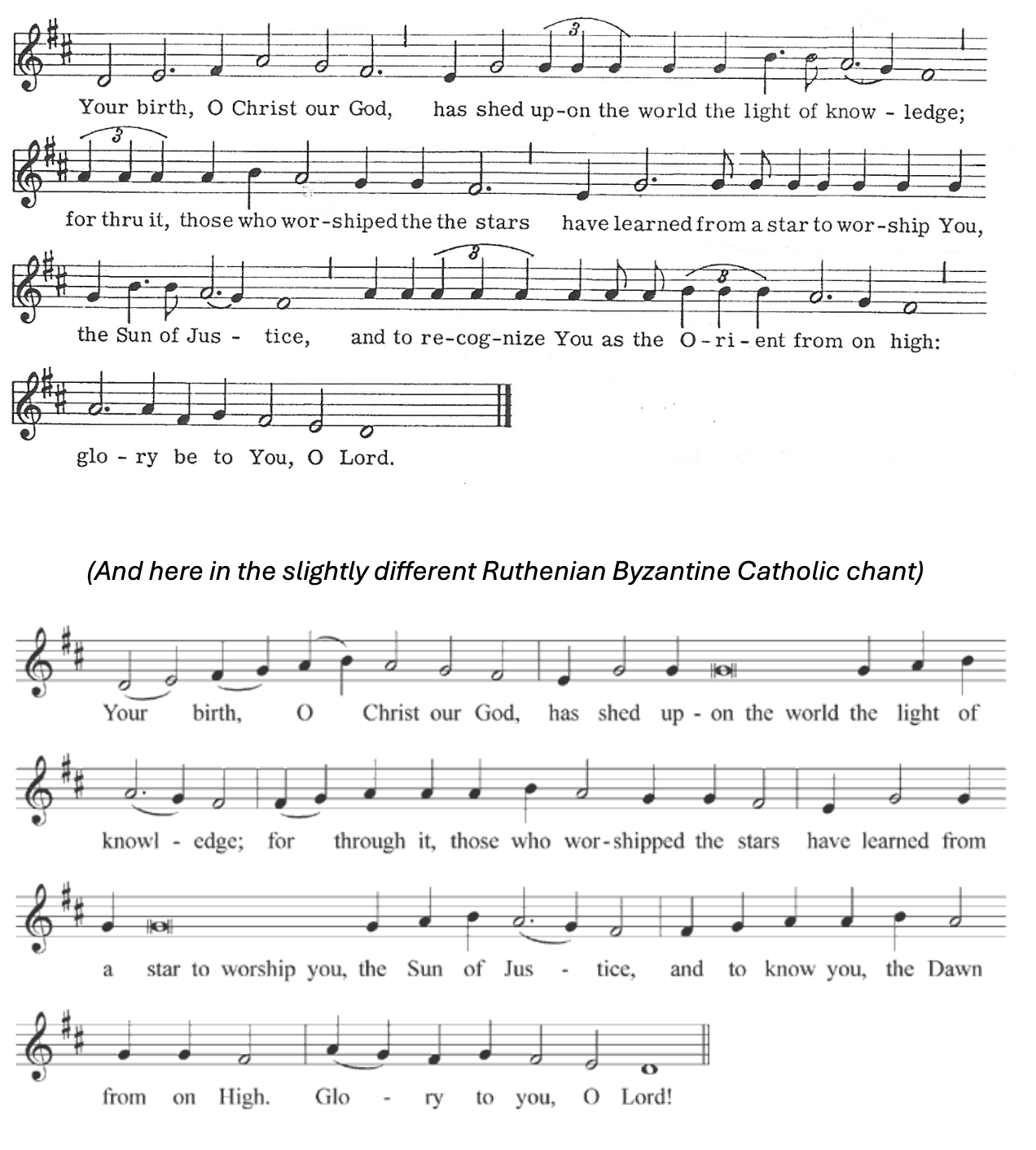
Sign of the Cross
The wife dips her finger into the small bowl of honey and anoints each person on the forehead with the sign of the cross.
Honey and Garlic
Next, she dips pieces of garlic into honey and gives each person a piece of garlic covered with honey.
The Supper
The first food to be eaten is the bread which is shared by all, reminding us that Christ is the Bread of Life.
Between the servings of each course, the meal is enhanced by the singing of carols, reminiscences of the past, and the telling of stories.
After the meal is over, all the dishes are removed, and the table is cleared except for the pastries, candies, nuts and fruits, and the beverages. These remain for the family and for anyone who may visit. The dishes are not cleaned at this time.
Conclusion of the Holy Supper
The husband prays extemporaneously thanking God for his blessings, and for the protection of all at the table. He concludes:
My dear family, I extend the best wishes of the Holy Christmas season. May Infant Jesus grant you all that you need and bless you with health and happiness now and during the New Year. Christ is born!
All answer:
Glorify Him!
Caroling
While the children search the room for the little presents and candies the father of the house has hidden, the adults begin to sing Christmas carols. The carol Silent Night is both appropriate and known by all to conclude the Holy Supper and to begin the caroling.
Notes
Most sources indicate that the husband ties the legs of the table with a chain or rope. This rite is given several meanings: to protect the fruit trees from wind damage, or family togetherness, or God's protection from danger from the four corners of the world, or so the bounty of the table would remain in the household during the coming year.
There are many additional rituals, most with superstitious meanings: only the wife could serve the meal, if anyone else left the table they would depart from the family; everyone has at least to taste all the courses; an axe was placed under the tablecloth to keep the tools from rust or under the table so all could place their feet on it to prevent foot problems; spreading poppyseeds around the house would chase away evil; a sheaf of wheat or oats called the diduch (forefathers) would be placed in a corner, the souls of the family ancestors who had resided in the fields and promoted the growth of the crops during the Summer. Now they came into the house with the arrival of the diduch.
Washing the hands and face to prepare for the coming of Christ was also seen as a way to insure that one stay healthy through the coming year. Other practices were to determine when or who the unmarried children would marry. There are many more customs.
In some traditions, Scripture readings are included. The suggested Old Testament reading is Isaiah 9:1-6, with the family responding antiphonally. New Testament readings include John 3:16-17, Matthew 5:14-16, and Romans 13:12. Some sources mention that the husband reads the Scripture after the meal is over and before the caroling. The Scriptures to be read at that time are the Nativity accounts in the Gospel according to Saint Matthew (2:1-12) and Saint Luke (2:1-20).